7 reflections from Silvertree’s Faith in the Workplace event
What does it mean to be a Christian in the workplace?

What does it mean to be a Christian in the workplace? Not just privately Christian. Not just Christian on Sundays. But faithfully, visibly and consistently Christian in the places where pressure, ambition, performance and compromise often meet.
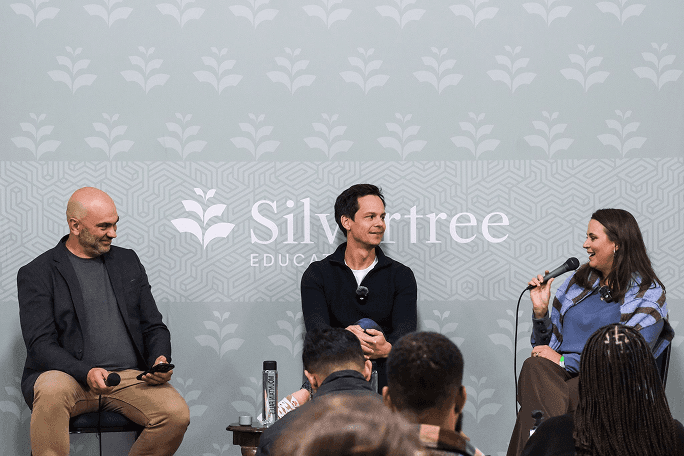
That was the question behind Silvertree Education’s recent Faith in the Workplace event, held on 22 April 2026 at Hofmeyrsaal in Stellenbosch. The evening featured Frederik Zietsman, CEO of Takealot Group, and Danelle Esterhuizen, CEO of Triga and former Sanlam Head of Innovation, in a conversation about what it means to follow Christ while carrying real responsibility in the world of work.
The theme echoed Jesus’ prayer in John 17. He does not pray that His followers would be removed from the world. Instead, He prays that they would be kept faithful within it. They are sent into the world, but they do not belong to it. That tension shaped the evening: Christians are called to live fully present in the workplace, while remaining rooted in Christ.
Here are seven reflections we took from the night.
1. Your identity comes before your role
One of the clearest themes of the evening was identity.
Before you are a CEO, founder, employee, manager, actuary, teacher or entrepreneur, you are first a child of God.
Work matters deeply. But it is something we steward. It is not who we are.
That distinction changes how we carry pressure. If our identity is rooted in performance, work becomes a place where we constantly need to prove ourselves. But if our identity is rooted in Christ, work becomes a place where we can serve, lead, build and remain faithful without being owned by the outcome.
2. The Christian way looks different
Danelle Esterhuizen offered one of the most memorable phrases of the evening:
Thick skin, soft heart.
It is a beautiful picture of Christian leadership. The workplace can reward the opposite. Thin skin and hard hearts. Defensiveness. Cynicism. Fear. Manipulation. Intimidation. Political games.
But the Christian way is different.
It is not weakness. It is not passivity. It is not avoiding hard conversations. It is strength under submission to God. The ability to absorb difficulty without becoming bitter. The courage to speak truth without becoming harsh. The willingness to lead with conviction while still carrying tenderness towards people.
3. Excellence creates a platform
Another strong theme was the role of excellence.
Not excellence as ego. Not excellence as image. But excellence as faithfulness. Work ethic matters. Truthfulness matters. Keeping your word matters. Being faithful in small things matters.
When Christians work hard, act with integrity and honour others even when it is difficult, people notice. Not always immediately. Not always loudly. But over time, trust is built. And trust creates a platform.
People begin to ask different questions. Why are you not giving up? Why are you not cutting corners? Why are you responding differently under pressure? Why do you carry yourself with peace?
That question often becomes the opening.
4. Do not despise small beginnings
The phrase “never despise small beginnings” came up more than once during the evening.
It was a reminder that faithfulness often starts quietly.
Small responsibilities. Small acts of obedience. Small moments of integrity. Small decisions to honour God when nobody is watching. In a world obsessed with scale, visibility and speed, that is deeply countercultural.
But the Kingdom often works through faithfulness before fruitfulness. If we cannot be trusted with what is small, why would we expect to be trusted with more?
5. Work and ministry are not enemies
The evening also challenged a false divide many Christians carry: the idea that ministry is sacred, while corporate work is somehow second-best. That is not the picture we were left with.
God can be glorified in boardrooms, classrooms, offices, startups, shops and teams. Corporate life is not a lesser calling if it is lived in faith.
What matters is not only what you do. It is how you live before God while doing it.
Influence, leadership and corporate responsibility can become places of worship when they are surrendered to God.
6. Frederik challenged the idea of “work-life balance”
Frederik Zietsman pushed back on the language of work-life balance. The issue is that life does not always fit into neat compartments. Some seasons are heavier than others.
Some responsibilities require more from us for a time. Some moments ask for sacrifice. But the Christian life is not about balancing Sunday against Monday.
It is about integration. One life. One faith. One posture before God.
That includes ambition, but also surrender. It includes hard work, but also Sabbath. It includes responsibility, but also trust. It includes leadership, but also accountability.
The challenge is not to live divided lives, but integrated ones.
7. Sabbath is an act of trust
One of the most practical challenges of the evening was around boundaries and Sabbath.
In a world that rewards constant availability, rest can feel irresponsible. But biblically, Sabbath is not laziness. It is trust. It says: God can do more with six days than I can do with seven.
That is a difficult thing to believe when your inbox is full, your targets are high and your responsibilities are real. But perhaps that is exactly why Sabbath matters. It reminds us that we are not God. The work is important, but it is not ultimate. We are called to be faithful, not frantic.
In the world, not of it
The workplace is not a distraction from discipleship.
For many of us, it is one of the main places where discipleship is tested and formed.
To be in the world but not of it does not mean withdrawing from work, ambition, excellence or leadership. It means entering those spaces with a different foundation.
A different identity. A different source of strength. A different way of leading. A different measure of success.
It means working hard, but not worshipping work.
It means leading strongly, but not through fear.
It means pursuing excellence, but not for self-glory.
It means being present in the world, while remaining rooted in Christ.
And perhaps that was the deepest encouragement of the evening: God is not absent from the workplace.
He is present there.
He is active there.
And for those willing to live integrated, faithful lives, the workplace can become one of the most powerful places to witness His goodness.

